Modern Home Drainage Solutions for Protecting Exterior Walls From Rainwater
Modern home drainage solutions play a critical role in protecting exterior walls from rainwater, moisture damage, staining, erosion, and long-term structural deterioration. A home may have high-quality exterior paint, durable cladding, and weather-resistant construction materials, but poor drainage can still allow water to accumulate around walls, foundations, window openings, and roof edges.
Rainwater should be collected, redirected, and discharged away from the building as efficiently as possible. When this does not happen, repeated wetting can create visible marks, encourage mold or algae growth, weaken finishes, and increase the risk of water entering cracks or joints.
Contemporary residential drainage systems use a combination of roof gutters, downpipes, channel drains, French drains, surface grading, rainwater outlets, soakaways, drainage membranes, and carefully positioned discharge points. These systems work together to manage water before it can damage the building envelope.
The most effective approach depends on roof design, soil conditions, rainfall intensity, site slope, wall materials, and the layout of patios, driveways, gardens, and paved surfaces around the home.
Why Rainwater Protection Is Important for Exterior Walls
Exterior walls are constantly exposed to weather.
Although most modern wall systems are designed to resist normal rain, repeated or concentrated water exposure can create problems.
Common signs of poor drainage include:
- Dark water stains
- Peeling paint
- Efflorescence
- Damp patches
- Mold or algae growth
- Cracked render
- Soil erosion near the foundation
- Water pooling beside walls
- Damaged cladding joints
Many of these problems begin outside before they become visible indoors.
Good drainage reduces the amount of water that remains in contact with the building and gives exterior materials a better chance to dry between rainfall events.
How Rainwater Reaches Exterior Walls
Water can affect walls in several ways.
Rain may strike the wall directly, but larger problems often occur when water is concentrated by the roof or surrounding surfaces.
Common sources include:
- Roof runoff
- Overflowing gutters
- Leaking downpipes
- Poorly graded soil
- Driveway runoff
- Patio drainage
- Blocked drains
- Irrigation systems
- Splashback from hard surfaces
Understanding the source is essential before selecting a drainage solution.
Roof Gutters for Controlled Rainwater Collection
Gutters are one of the most important components of residential drainage.
They collect rainwater from the roof edge and direct it toward downpipes.
Without effective gutters, large amounts of water can fall directly beside the exterior walls.
This may cause:
- Splash staining
- Foundation saturation
- Soil erosion
- Moisture penetration
Modern gutter systems are available in aluminum, steel, PVC, copper, and other materials.
The size should match the roof area and expected rainfall.
Seamless Gutters
Seamless gutters are manufactured in long continuous sections with fewer joints.
This reduces the number of potential leakage points.
They also create a cleaner appearance on modern homes.
Common advantages include:
- Reduced joint leakage
- Neater roofline
- Lower maintenance
- Custom sizing
They are particularly suitable for long roof edges.
Box Gutters for Contemporary Architecture
Box gutters are often integrated into modern roof designs.
They may be concealed behind parapets or built into the roof structure.
This creates a minimalist appearance because the drainage system is less visible.
However, concealed gutters require careful detailing.
Poor installation or blocked outlets can allow water to overflow into the building.
Regular inspection is therefore essential.
Downpipes for Moving Water Away From Walls
Downpipes carry rainwater from roof gutters toward ground-level drainage.
They should discharge into an appropriate drainage system rather than allowing water to collect at the base of the wall.
Common downpipe materials include:
- PVC
- Aluminum
- Steel
- Copper
Downpipes should be securely fixed and sized for the expected flow rate.
Leaks at joints can cause repeated wetting of the wall behind them.
Downpipe Extensions
A downpipe that ends directly beside the foundation may still create moisture problems.
Extensions can direct water farther away.
These may include:
- Above-ground extensions
- Flexible pipes
- Underground connections
- Splash blocks
The discharge point should be positioned where water can drain safely.
Underground Downpipe Drainage
Modern homes often connect downpipes to underground drainage pipes.
This creates a cleaner exterior appearance and keeps runoff away from the foundation.
The underground system may discharge into:
- Stormwater drains
- Soakaways
- Dry wells
- Rainwater tanks
- Approved drainage areas
Access points should be included for maintenance and blockage removal.
French Drains Around Exterior Walls
French drains are commonly used where water accumulates near the building.
A typical system includes:
- Perforated drainage pipe
- Gravel
- Filter fabric
- Sloped trench
Water enters through the gravel and pipe openings before being carried away from the wall.
French drains can be useful along:
- Basement walls
- Sloped properties
- Garden edges
- Retaining walls
They are particularly valuable where surface water repeatedly moves toward the house.
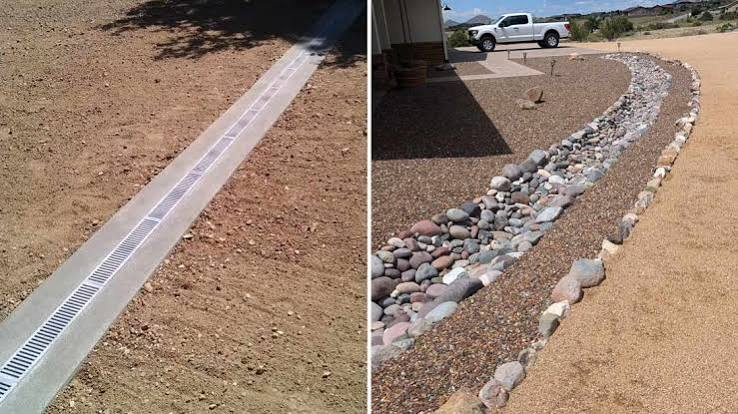
Channel Drains Near Patios and Doors
Channel drains collect water from hard surfaces before it reaches the wall.
They are often installed along:
- Patios
- Driveways
- Balconies
- Garage entrances
- Sliding doors
A long narrow grate sits at surface level and captures runoff.
This is especially useful where paving slopes toward the building.
Modern channel drains are available with:
- Stainless-steel grates
- Black grates
- Slot drains
- Tile-in covers
These options can blend with contemporary exterior designs.
Slot Drains for Minimalist Exteriors
Slot drains provide a more discreet appearance than conventional grated channels.
Only a narrow opening remains visible at the surface.
They work especially well around:
- Modern patios
- Pool decks
- Courtyards
- Large glass doors
Slot drains can provide effective drainage without interrupting the clean appearance of paving.
However, proper maintenance is still necessary to prevent blockage.
Surface Grading Around the Home
Ground slope is one of the simplest and most important drainage strategies.
The soil and paving immediately around the house should generally slope away from the exterior walls.
This encourages water to move away naturally.
Poor grading can cause water to remain against the foundation even when gutters are working correctly.
Common Grading Problems
Problems may include:
- Sunken soil
- Settlement beside foundations
- Raised garden beds
- Improper paving slopes
These conditions can direct water back toward the house.
Drainage Around Driveways
Driveways can collect large amounts of rainwater.
If the driveway slopes toward the building, runoff may reach:
- Garage walls
- Entrance doors
- Foundations
Channel drains or trench drains can intercept this water.
They should be positioned across the flow path before water reaches the building.
Patio Drainage Solutions
Modern patios often use large-format tiles, concrete, stone, or porcelain.
These surfaces absorb little water, meaning runoff must be managed carefully.
Possible solutions include:
- Channel drains
- Slot drains
- Permeable joints
- Correct surface slope
The patio should not direct water toward exterior doors or walls.
Permeable Paving
Permeable paving allows rainwater to pass through the surface rather than running across it.
This can reduce surface runoff around the home.
Options include:
- Permeable concrete pavers
- Gravel systems
- Porous paving blocks
They can be especially useful on:
- Driveways
- Garden paths
- Courtyards
The base layers must be correctly designed for drainage.
Rain Gardens
Rain gardens can provide an attractive way to manage runoff.
They are shallow planted areas designed to temporarily collect rainwater.
Water can then infiltrate into the soil.
Rain gardens may receive runoff from:
- Roofs
- Downpipes
- Patios
They should be located away from foundations and designed according to soil and drainage conditions.
Soakaways and Dry Wells
A soakaway or dry well stores rainwater temporarily and allows it to disperse into surrounding soil.
These systems may receive water from roof downpipes or surface drains.
They can be useful where direct storm-drain connections are unavailable.
However, they are not suitable for every soil type.
Poorly draining soil may require a different solution.
Rainwater Harvesting Tanks
Rainwater tanks collect roof runoff for later use.
Depending on local regulations and system design, stored water may be used for:
- Garden irrigation
- Outdoor cleaning
- Toilet flushing
- Other non-potable uses
A rainwater tank reduces the amount of runoff discharged around the building.
Overflow must still be directed safely away from exterior walls.
Drainage Membranes on Exterior Walls
Below-ground walls may require additional moisture protection.
Drainage membranes can be installed against foundation walls to create a pathway for water to move downward toward drains.
These systems may use:
- Dimpled membranes
- Waterproof coatings
- Drainage boards
They are particularly useful for:
- Basements
- Retaining walls
- Partially buried structures
They should be combined with suitable foundation drainage.
Foundation Drains
Foundation drains are installed around the base of below-ground walls.
They collect groundwater and surface water before it builds pressure against the structure.
A typical foundation drain includes:
- Perforated pipe
- Gravel surround
- Filter fabric
The pipe must slope toward a suitable outlet.
Poorly installed foundation drains can become blocked by sediment.
Protecting Rendered Exterior Walls
Rendered walls can develop stains or cracking if they remain wet for long periods.
Drainage protection should include:
- Effective roof overhangs
- Working gutters
- Proper ground clearance
- Splash protection
The bottom of the render should not remain in constant contact with wet soil.
Protecting Brick Walls
Brick is durable but can absorb water.
Poor drainage may cause:
- Efflorescence
- Mortar deterioration
- Damp staining
Gutters and surface drainage help reduce repeated saturation.
Weep holes and cavity drainage should also remain clear where applicable.
Protecting Timber Cladding
Timber cladding requires good drying conditions.
Repeated exposure to trapped moisture may cause:
- Warping
- Rot
- Discoloration
Drainage systems should prevent standing water near the base of the wall.
Adequate clearance from soil and paving is also important.
Protecting Fiber Cement and Composite Cladding
Fiber cement and composite materials are often more moisture resistant than timber, but their joints and backing systems still need proper drainage.
Water should not be allowed to collect behind panels.
Correct flashing and drainage cavities are essential.
Roof Overhangs as Passive Rain Protection
Roof overhangs reduce the amount of direct rain striking exterior walls.
They are particularly effective above:
- Windows
- Doors
- Upper walls
Deep overhangs can also provide shade.
However, roof overhangs do not replace gutters and drainage systems.
Wind-driven rain can still reach walls.
Drip Edges and Flashings
Drip edges help direct water away from roof edges and wall surfaces.
Flashing is also used around:
- Windows
- Doors
- Roof intersections
- Parapets
- Cladding joints
Poor flashing can allow water to move behind exterior finishes.
Correct detailing is essential for long-term moisture protection.
Window Sills and Drainage
Exterior window sills should slope outward so rainwater drains away from the wall.
They may also include drip grooves underneath.
Without these features, water can run back toward the facade.
This can cause staining below windows.
Balcony Drainage
Balconies require dedicated drainage because they collect direct rainfall.
Possible systems include:
- Floor drains
- Scuppers
- Channel drains
- Overflow outlets
Balcony surfaces should slope toward drainage points.
Water should never be allowed to flow continuously down exterior walls.
Scuppers for Roof and Balcony Drainage
Scuppers are openings through parapet walls that allow water to exit.
They are commonly used on:
- Flat roofs
- Balconies
- Terraces
A scupper may discharge into a downpipe or outward through a decorative outlet.
Overflow scuppers can provide backup protection if primary drains become blocked.
Flat Roof Drainage
Flat roofs require especially careful drainage.
Even roofs described as flat should usually have enough slope to move water toward outlets.
Drainage may include:
- Internal roof drains
- Scuppers
- Box gutters
- Downpipes
Standing water increases stress on waterproofing systems.
Overflow Drainage
Primary drains can become blocked by leaves or debris.
Overflow drainage provides a secondary escape path.
It can reduce the risk of water building up until it reaches walls or interior spaces.
Overflow outlets are especially important on concealed gutter and flat-roof systems.
Gutter Guards
Gutter guards can reduce the amount of debris entering gutters.
They may help prevent blockages caused by:
- Leaves
- Twigs
- Seeds
However, gutter guards still require inspection.
Fine debris can accumulate over time.
Leaf Traps and Downpipe Filters
Leaf traps can be installed at downpipes to prevent larger debris from entering underground drainage systems.
These are useful where:
- Trees are close to the roof
- Underground pipes are difficult to access
Easy-clean designs simplify maintenance.
Smart Rainwater Monitoring
Modern drainage systems can include sensors and monitoring devices.
Possible features include:
- Water-level sensors
- Tank overflow alerts
- Leak sensors
- Smart pumps
These technologies can provide early warning of drainage problems.
They are especially useful in larger homes or properties with concealed systems.
Sump Pumps for Low-Lying Areas
Some properties cannot drain water by gravity.
In these situations, a sump pump may collect and pump water to a higher discharge point.
Sump systems are commonly used around:
- Basements
- Underground garages
- Low courtyards
Backup power may be important where flooding risk is significant.
Drainage for Sloped Sites
Homes built on sloping land require careful water management.
Surface runoff naturally moves downhill.
If the home is located in the flow path, drainage may be needed uphill of the building.
Possible solutions include:
- Interceptor drains
- Swales
- French drains
- Retaining wall drainage
The goal is to redirect water before it reaches exterior walls.
Swales for Landscape Drainage
A swale is a shallow shaped channel in the landscape.
It guides water toward a safe drainage area.
Swales can be integrated into garden design and planted with grass or vegetation.
They are useful for managing larger amounts of surface runoff.
Retaining Wall Drainage
Retaining walls can hold back wet soil.
Without drainage, hydrostatic pressure may build behind the wall.
Drainage solutions may include:
- Weep holes
- Gravel backfill
- Perforated drain pipes
Proper retaining wall drainage can also help protect nearby house walls.
Managing Splashback Near Walls
Hard surfaces can cause rainwater to splash upward against the lower wall.
This can create:
- Dirt marks
- Algae
- Moisture staining
Gravel borders around the base of the wall can reduce splashback.
A narrow drainage strip may also improve water movement.
Gravel Drainage Strips
Gravel strips are simple and visually compatible with modern architecture.
They can be installed between the exterior wall and nearby paving.
Benefits may include:
- Reduced splashback
- Better surface drainage
- Cleaner wall base
- Decorative contrast
The underlying ground should still slope appropriately.
Drainage Around Outdoor Air-Conditioning Units
Mechanical equipment should not block water flow.
Outdoor units can create difficult drainage zones near walls.
The surrounding area should allow water to move away freely.
Condensate lines should also discharge into suitable drainage locations rather than saturating the foundation area.
Drainage Near Exterior Doors
Water accumulation near doors can damage:
- Frames
- Thresholds
- Interior flooring
Threshold drainage may include narrow channel drains positioned immediately outside the opening.
This is particularly important for low-threshold sliding doors.
Maintaining Modern Drainage Systems
Even the best drainage design requires maintenance.
Routine tasks may include:
- Cleaning gutters
- Clearing downpipes
- Removing drain debris
- Inspecting grates
- Checking soil slope
- Cleaning filters
Maintenance is particularly important before heavy rainfall seasons.
Signs of Drainage Failure
Warning signs include:
- Overflowing gutters
- Water pooling beside walls
- Damp stains
- Soil erosion
- Moss or algae
- Cracked paving
- Water near door thresholds
These symptoms should be investigated early.
Small drainage issues can become more expensive if ignored.
Common Home Drainage Mistakes
Several common mistakes can expose exterior walls to unnecessary moisture.
These include:
- Downpipes ending beside the wall
- Paving sloping toward the house
- Blocked gutters
- Undersized drains
- Raised soil levels
- Missing overflow outlets
- Poorly positioned irrigation
- No maintenance access
A drainage system should be planned as a complete network rather than as separate components.
Choosing the Right Drainage Solution
The correct solution depends on site conditions.
Homeowners should consider:
- Roof size
- Rainfall intensity
- Soil type
- Ground slope
- Foundation type
- Wall materials
- Paved areas
- Local drainage regulations
A flat urban property may require channel drains and underground pipes, while a sloping site may benefit from interceptor drains and swales.
Professional Drainage Assessment
Persistent moisture problems may require professional investigation.
A drainage specialist, builder, or engineer can assess:
- Water flow
- Ground levels
- Soil drainage
- Existing pipe condition
- Foundation exposure
Professional assessment is especially important where water is entering basements or damaging structural components.
Frequently Asked Questions
What is the best way to keep rainwater away from exterior walls?
A combination of effective gutters, downpipes, proper surface slope, and suitable ground drainage is usually the most effective approach.
Should downpipes discharge directly beside the house?
No. Water should normally be directed to an approved drainage system or discharged a safe distance from the foundation.
Do French drains protect exterior walls?
Yes. French drains can intercept groundwater and surface water before it accumulates beside walls.
Are channel drains useful near patios?
Yes. They can collect runoff from paved surfaces before it reaches doors or exterior walls.
Can poor drainage damage exterior paint?
Yes. Repeated wetting can cause staining, peeling, blistering, or deterioration depending on the wall finish.
Are gutters enough to protect a house from rainwater?
No. Gutters are important, but ground drainage, downpipe discharge, surface grading, and wall detailing are also necessary.
How often should gutters be cleaned?
The frequency depends on surrounding trees and local conditions. They should be inspected regularly and cleaned whenever debris begins to restrict flow.
Can rainwater tanks reduce drainage problems?
They can reduce some roof runoff by storing water, but tank overflow still needs to be directed safely away from the building.
Final Thoughts
Modern home drainage solutions protect exterior walls by controlling rainwater from the moment it reaches the roof until it is safely discharged away from the building. Gutters and downpipes manage roof runoff, while channel drains, French drains, surface grading, soakaways, and landscape drainage systems control water at ground level.
Contemporary homes can also benefit from concealed box gutters, minimalist slot drains, rainwater harvesting tanks, drainage membranes, smart monitoring, and carefully designed landscape features. However, attractive design should never compromise drainage performance.
The most effective system is one that considers the property as a complete water-management network. Roof drainage, wall detailing, paving slopes, soil conditions, balcony outlets, foundation protection, and maintenance access should all work together.
By directing rainwater away quickly and consistently, homeowners can reduce staining, moisture buildup, erosion, and premature deterioration while helping exterior walls remain cleaner, drier, and more durable over the long term.