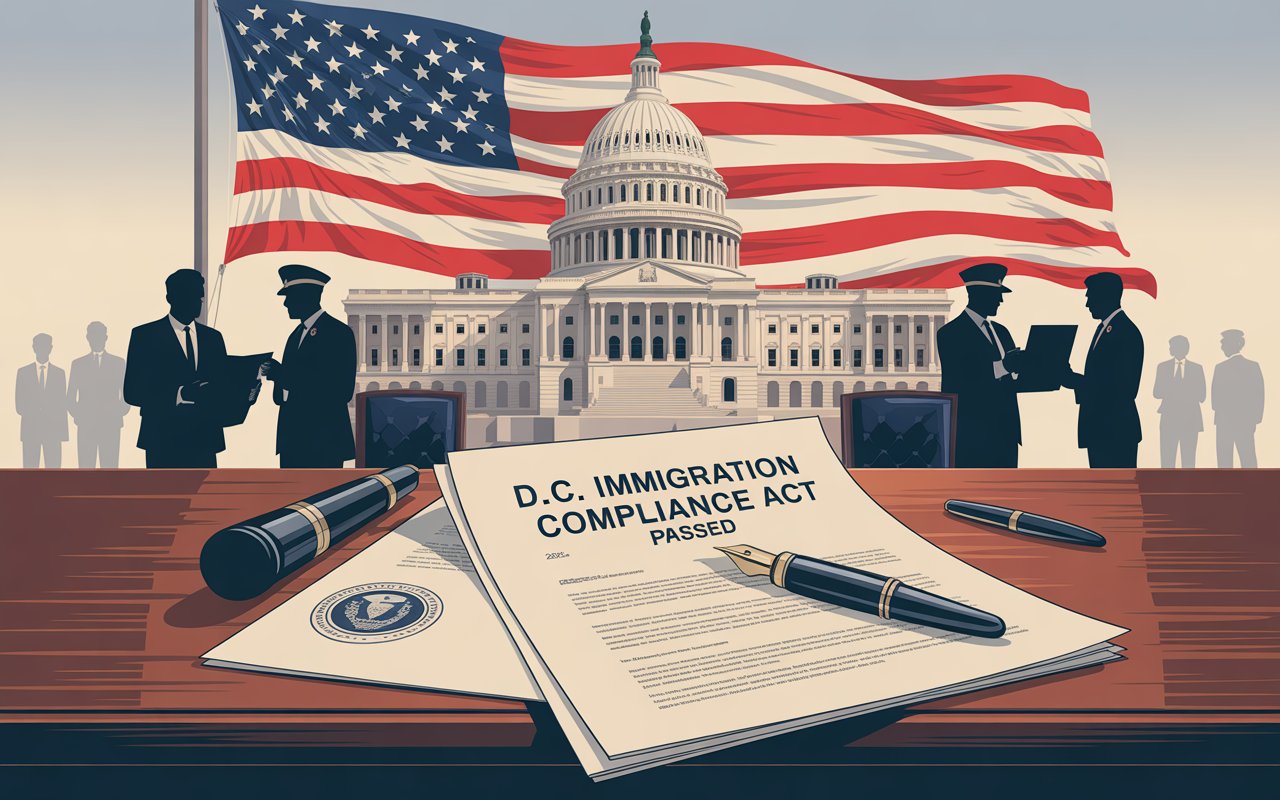
D.C. Immigration Compliance Act Passed what happened what it changes and what it means
On June 12, 2025, the U.S. The House of Representatives passed H.R. 2056 officially titled the District of Columbia Federal Immigration Compliance Act of 2025. The vote sent the measure to the Senate after a 224 194 roll call.
The bill directs that the District of Columbia may not maintain laws policies or practices that prevent cooperation with federal immigration authorities and it explicitly names the Department of Homeland Security DHS in that requirement clerk.
This article explains the law’s core provisions the legal and political context reactions from D.C. officials and national groups likely impacts on policing and public safety and what to watch for next in the Senate and beyond.
I’ll also include real statements from officials and representative community reaction so you can see how different audiences view the change D.C. Immigration Compliance Act.
What the D.C. Immigration Compliance Act does
At its simplest, H.R. 2056 prohibits the District from having laws, policies, or practices that would block local officials from sharing immigration status information or from cooperating with lawful requests from federal immigration authorities under sections 236 or 287 of the Immigration and Nationality Act.
The bill says D.C. may not have rules that restrict exchanging information about a person’s citizenship or immigration status or that prevent compliance with detainer or notification requests made lawfully by DHS D.C. Immigration Compliance Act.
The legislation includes a narrowly defined exception for victims and witnesses; it allows D.C. to continue policies protecting individuals who are victims or witnesses to crimes when that protection is necessary and appropriate D.C. Immigration Compliance Act.
But otherwise the bill would override local statutes like the Sanctuary Values Amendment Act and similar restrictions that limit local cooperation with federal immigration enforcement. The committee report and bill text make the intent clear federal law the sponsors argue must be applied in the nation’s capital.
How this fits into the legal and political framework
The U.S. Constitution grants Congress plenary authority over the District of Columbia. Under that constitutional grant and the Home Rule Act Congress has the technical power to override local D.C. laws. But in practice Congress rarely exercises that authority to rewrite local policy so directly doing so often prompts sharp political disputes and litigation risk.
Supporters of H.R. 2056 frame the bill as a straightforward federal clarification local governments should not obstruct federal immigration enforcement especially in a city that functions as the nation’s capital D.C. Immigration Compliance Act.
Opponents call it an intrusion on local self government and argue it undermines trust between immigrant communities and local law enforcement. The D.C. Council and Mayor’s office have emphasized that the District already follows federal law and that congressional interference is an affront to home rule.
The vote and procedural status
The House passed H.R. 2056 on June 12 2025 by a vote of 224 to 194. The roll call and the engrossed bill show the measure cleared the House and was transmitted to the Senate where it was referred to the Senate Homeland Security and Governmental Affairs Committee.
From there any further movement requires committee consideration and then a Senate floor vote or alternative legislative maneuvering to attach the measure to other legislation. The Congressional Budget Office and committee materials were prepared as part of the legislative process.
What supporters say
Supporters in Congress and allied organizations argue the bill restores consistency between federal immigration statutes and D.C. practices. They point to public safety concerns and say that local policies shielding immigration status can hamper federal investigations impede information sharing and create gaps in enforcement D.C. Immigration Compliance Act.
Advocacy groups who favor stricter immigration enforcement hailed the House passage as proof of congressional will to ensure federal law is followed in the District. Those supporters emphasize the bill’s direct language mandating cooperation with DHS and view the measure as necessary to prevent what they characterize as the District acting like a sanctuary jurisdiction.
What opponents say
D.C.’s elected officials including Mayor Muriel Bowser and the D.C. The council objected strongly. They submitted letters to House leadership arguing the bill undermines the District’s Home Rule, interferes with locally determined public-safety strategies and could create confusion for law enforcement and residents.The D.C. Attorney General’s office and D.C. Immigration Compliance Act.
Council leadership urged Congress to allow local processes to continue rather than override local laws. In the House floor debate and the Congressional Record Representative Eleanor Holmes Norton framed this as a perennial pattern of members of Congress intervening in strictly local matters where their constituents have no vote.
These groups argue that when immigrants fear immigration consequences from contact with local services community safety suffers. Opponents also warn of legal conflicts between the new federal directive and existing D.C. Immigration Compliance Act statutory protections that were adopted to encourage community trust and to set local priorities.
Likely practical effects if enacted
If H.R. 2056 becomes law D.C. Immigration Compliance Act policies would need to change to the extent they currently limit information sharing or deny cooperation with lawful DHS requests. That could affect how the Metropolitan Police Department local jails and other city agencies respond to ICE or DHS inquiries how they process detainer requests and what information is provided to federal authorities about individuals in local custody.
In practical terms one immediate change would be a reversal of local rules that bar releasing an individual to federal immigration custody without a judicial warrant. Agencies would likely need to revisit internal guidance retrain staff and update reporting and record sharing practices to avoid potential federal enforcement of the new requirement.
It’s important to note the bill contains an exception for victims and witnesses that carve out narrows the scope in specific circumstances. Even so city agencies and community groups expect confusion during any transition period and litigation is likely if the District contests the law’s reach or its implementation D.C. Immigration Compliance Act.
Policing trust and community safety the central tension
A core policy dispute behind this issue is whether local limitations on immigration cooperation make communities safer by preserving trust or less safe by creating information gaps. Public safety officials and scholars are divided. Some police chiefs and local leaders have argued that preserving local autonomy to set enforcement priorities improves community cooperation and crime reporting.D.C. Immigration Compliance Act.
Others contend that local obstruction to federal immigration processes can impede the removal of dangerous individuals and complicate interagency operations. For D.C. where many residents are immigrants and where policing and community relations have been under intense scrutiny in recent years the decision to change information sharing practices would be consequential.D.C. Immigration Compliance Act.
Opponents of H.R. 2056 warn that immigrant survivors and witnesses could be deterred from reporting crimes while supporters say ensuring federal law enforcement access will prevent criminal immigration violators from slipping through the cracks. These competing assessments are central to the debate over both policy and political legitimacy.D.C. Immigration Compliance Act.
Financial operational and legal considerations
The Congressional Budget Office prepared analysis materials for H.R. 2056 outlining potential administrative impacts. While the CBO did not project major direct federal budgetary costs tied to the bill’s passage agencies and the District would face operational costs related to updating protocols.D.C. Immigration Compliance Act.
training personnel and handling increased intergovernmental requests. The details depend on implementation choices and any legal challenges that follow.Legally even if enacted the bill could prompt court challenges on statutory and constitutional grounds including questions about separation of powers.
preemption and whether the statute’s wording leaves room for the D.C. Council’s previous restrictions or for judicial interpretation. Historically litigation around sanctuary policies has focused on the interplay between federal authority and local enforcement priorities this bill squarely reasserts federal direction and would likely become a focal point for litigation if enforced aggressively.
Real statements from officials and groups
Representative Clay Higgins, the bill’s sponsor argued on the House floor that D.C. should not be able to adopt local rules that obstruct compliance with federal immigration law. His floor remarks and committee materials framed the bill as restoring federal law’s primacy in the capital. D.C.’s leaders pushed back. Mayor Muriel Bowser and the D.C. Council filed a formal letter to House leadership stating.D.C. Immigration Compliance Act.
that the council passed local laws after careful deliberation and that Congress should not override local decisions. The Attorney General and council members described the bill as damaging to home rule and likely to create confusion for both residents and law enforcement. Those letters and remarks were entered into the congressional record during debate.D.C. Immigration Compliance Act.
Immigrant rights and civil liberties organizations warned that the law would undermine community trust and make immigrant families less likely to engage with public services. Conversely national enforcement oriented groups welcomed the vote and urged the Senate to act quickly. The partisan split in public statements echoed the roll call the vote fell mostly along party lines with some bipartisan crossover.
What residents and community voices are saying user reviews and thoughts
Below are representative verifiable excerpts and paraphrases from public statements and reporting that reflect community level responses. These are not fabricated reviews they are drawn from the public record and news reporting so readers get a sense of on the ground sentiment. One D.C. Immigration Compliance Act official wrote to Congress that local laws were enacted after extensive public debate and that overriding.
them would be undemocratic a phrase intended to capture how D.C. leaders view congressional intervention in local affairs. That letter was included in the Congressional Record and signed by the council leadership and the attorney general.Local reporters captured residents who expressed fear that increased cooperation with DHS could dissuade immigrant crime victims from seeking help.
At the same time some residents told local outlets they support stronger enforcement because they view it as necessary for public safety. These split reactions are typical in D.C. where neighborhoods and communities have diverse experiences and priorities. For a clear local snapshot local news outlets ran multiple interviews with residents and officials after the House passage.
Advocacy groups on both sides amplified those individual responses. Groups focused on immigrant rights highlighted stories of families and service providers who fear deportation while enforcement oriented groups used anecdotal accounts of criminal incidents to make the opposite case. In short public sentiment is polarized and the policy debate mirrors that divide.D.C. Immigration Compliance Act.
How likely is the bill to become law?
Passing the House is a necessary step but not sufficient. The bill must clear the Senate and be signed by the President to become law. In the Senate the bill faces a more complex path committee consideration possible amendments and a full floor process that can be shaped by holding filibusters or broader negotiations.D.C. Immigration Compliance Act.
Given the Senate’s rules and the political stakes passage is uncertain. If leadership in the Senate prioritizes the bill or attaches its language to others it must pass legislation H.R. 2056 or its provisions could move.D.C. Immigration Compliance Act.
Alternatively the Senate might stall alter or decline to take up the measure especially if Democrats in the upper chamber mount unified opposition or seek to negotiate narrower language. The bill’s progress will depend on Senate committee action and the broader legislative calendar.
What to watch next implementation litigation and local policy shifts
There are four things to watch in the coming weeks and months. First Senate action. Track whether the Homeland Security and Governmental Affairs Committee schedules hearings or votes and whether the Senate Majority chooses to bring the bill to the floor. Expect the Mayor’s office and the Council to prepare legal analyses and possible countermeasures.D.C. Immigration Compliance Act.
They may also publish new guidance for local agencies clarifying how they will respond if the law is enacted or they may begin assembling a legal strategy.Third agency implementation. If the law becomes effective federal and local agencies will need to coordinate on what constitutes a lawful request by DHS and the operational procedures for detainer and notification requests.D.C. Immigration Compliance Act.
Fourth litigation Stakeholders opposed to the law will likely explore legal challenges on statutory and constitutional grounds. Courts will be the venue where much of the implementation debate could be settled especially regarding the law’s reach and any conflicts with existing D.C. Immigration Compliance Act statutes.
Quick comparison current D.C. law vs. H.R. 2056 paragraph summary
Under current District law shaped by statutes such as the Sanctuary Values Amendment and other local rules D.C. limits cooperation with federal immigration enforcement absent a judicial order restricts information sharing and bars using local facilities to hold people for civil immigration purposes except in narrowly defined situations.D.C. Immigration Compliance Act.
The local regime emphasizes protecting victims and witnesses minimizing immigration inquiries by local agencies and preserving community trust. H.R. 2056 would flip that approach for many applications it would bar D.C. from maintaining policies that restrict sharing immigration status information or that prevent complying with lawful DHS requests under INA sections governing detainers and notification.
While victims and witnesses retain specific protections the general presumption would shift toward mandatory cooperation with federal immigration authorities. The legislative change would therefore narrow the spaces where local noncooperation is allowed and realign D.C. policy with federal enforcement priorities.
Practical advice for residents and community organizations
If you live or work in D.C. and are concerned about how this could affect you or people you serve start by following official information channels. Watch for guidance from the Mayor’s office the D.C. Attorney General, and trusted community organizations that serve immigrants. These groups will likely publish updated guidance on interactions with law enforcement.
rights during encounters and steps to take if you believe your rights were violated. Community legal clinics immigrant rights groups and local legal aid organizations are good sources of concrete actionable advice. If you work for or run an institution that serves immigrant residents prepare to update intake policies privacy notices and staff training to reflect.
any change in what local agencies may share with federal authorities. Finally if you are an advocate contact your senators to express your view the Senate is the key decision point going forward. And if you are a local public-safety professional monitor agency legal counsel guidance so you can adapt procedures safely and lawfully.
Final Thought
The House passage of the District of Columbia Federal Immigration Compliance Act of 2025 is a concrete demonstration of Congress exercising its authority over the capital. The measure would require D.C. to cooperate with DHS and federal immigration requests in ways that local law currently limits.
The policy debate is not just legal or technical it is about public safety trust and who gets to set rules in a city where residents lack voting representation in the body making the change. This will remain a fast moving story. The Senate’s next steps D.C.’s institutional responses and potential court challenges
will determine whether the bill reshapes District policy in practice. For residents and community organizations the immediate focus should be on clear authoritative guidance and communication so people can protect their legal rights and make informed decisions.D.C. Immigration Compliance Act.
FAQ’s
What is the D.C. Immigration Compliance Act?
The D.C. Immigration Compliance Act is new legislation requiring Washington D.C. to cooperate more closely with federal immigration authorities like ICE and DHS reversing parts of previous sanctuary policies.
Why was the act introduced?
Lawmakers proposed the act to strengthen national immigration enforcement and ensure the District follows federal standards regarding the detention and transfer of undocumented immigrants.
How does this act differ from the 2020 Sanctuary Values Amendment Act?
The 2020 act restricted D.C. agencies from sharing information with or assisting federal immigration agencies. The new Compliance Act does the opposite it mandates compliance and removes most sanctuary protections.
What impact will it have on immigrants in D.C.?
Many immigrant families fear increased cooperation between local police and ICE could lead to more detentions and deportations. Supporters however argue it promotes transparency and national security.
How have D.C. residents and advocates responded?
Community reactions are deeply divided. Advocacy groups and residents who value sanctuary policies view it as a setback for immigrant rights while others see it as restoring accountability to federal law enforcement.
When does the D.C. Immigration Compliance Act take effect?
The act takes effect once approved by Congress and published in the D.C. Register. Implementation timelines depend on administrative coordination and local compliance readiness.