
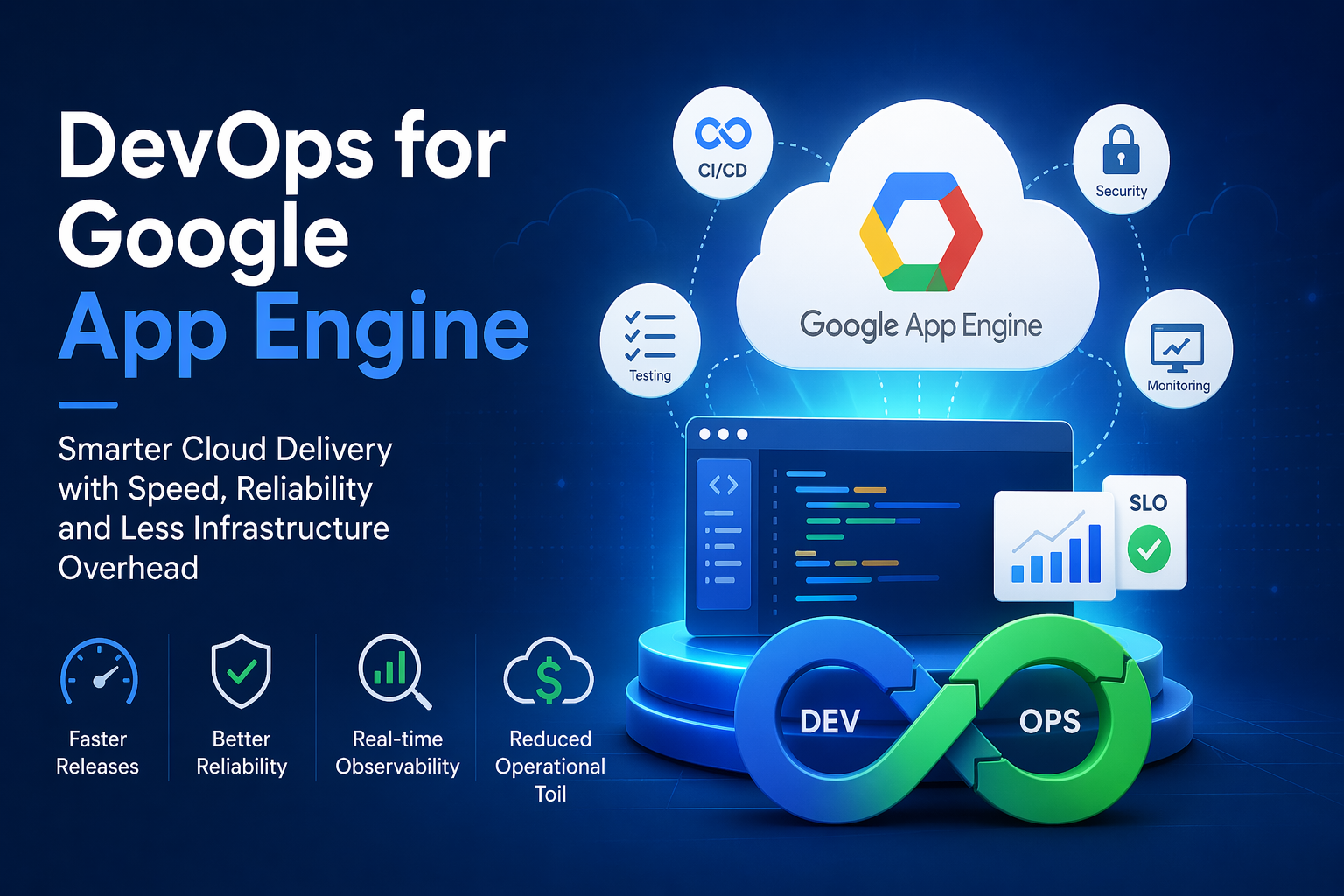
Is DevOps for Google App Engine the Next Step in Smarter Cloud Delivery
Cloud delivery is no longer judged only by release speed. Teams are now measured on resilience, developer productivity, security, and cost control together.
That is why DevOps for Google App Engine is becoming a sharper strategic conversation for businesses that want faster releases without more platform burden.
App Engine is managed and handles provisioning and scaling, while DevOps thinking is moving toward platform engineering, AI-assisted workflows, and delivery models shaped by reliability targets rather than approvals.
Why Managed Cloud Delivery Is Moving Beyond Basic Automation Models
Many cloud teams already have CI/CD in place, yet delivery still slows when releases depend on manual checks, fragmented ownership, or weak production visibility.
The shift now is toward simpler developer paths, stronger deployment guardrails, and shared operating standards. Current cloud delivery guidance also puts more attention on supply chain security, cost optimization, and operating discipline across the full release cycle.
This is where a Google App Engine DevOps strategy becomes more relevant. Instead of spending engineering time on server maintenance, teams can focus on release quality, rollback readiness, and application performance.
How App Engine Fits New DevOps Priorities Across Modern Product Teams
App Engine suits teams that want managed infrastructure with room for disciplined release practices. It supports autoscaling and removes much of the routine provisioning burden, which gives engineering leaders more space to improve release governance and service reliability.
Platform engineering also points to reducing cognitive load so delivery teams can move faster with less operational drag.
In practical terms, DevOps for Google App Engine works best when it is tied to a few clear operating goals:
- Shorter feedback loops from commit to deployment.
- Repeatable pipelines with policy checks built in.
- Service monitoring mapped to business-critical journeys.
- Rollback decisions based on SLOs, not guesswork.
- Reduced toil for teams managing frequent releases.
Enterprises do not only want deployment automation. They want a model that joins development, operations, observability, and governance in one flow.
What Smarter Delivery Looks Like With Reliability and Release Discipline
A strong App Engine DevOps approach is not only about shipping faster. It is about shipping with fewer surprises. SLOs, error budgets, and burn-rate signals help teams decide when change is safe and when production reliability needs protection.
For business teams, this translates into clearer operational value:
- Incident response becomes more measurable.
- Releases are tied to service health, not only sprint deadlines.
- Reams reduce unnecessary downtime risk during updates.
- Product changes reach users without long infrastructure cycles.
Leaders now expect engineering systems to support both speed and control without forcing teams into heavy ops overhead.
Why Platform Thinking Is Shaping DevOps on App Engine Right Now
One of the strongest trends influencing DevOps for Google App Engine is platform thinking. Internal platforms, reusable workflows, and lower delivery complexity are becoming central to engineering models. The goal is no longer to give every team more tools. The goal is to give them a better path to production.
That makes App Engine useful for organizations that want to standardize delivery without overengineering infrastructure. A cloud operations model can combine:
- Managed runtime simplicity.
- Automated testing and deployment gates.
- Observability linked to SLO-based decisions.
- Secure release workflows with less manual handoff.
- AI-assisted development used within a stronger delivery framework.
This is also where Pattem Digital can add value. Businesses often need structure as much as they need tooling, especially when cloud adoption has outpaced delivery maturity.
Where Service Expertise Strengthens Enterprise Cloud Execution Outcomes
Enterprises exploring Google App Engine services often need more than setup support. They need operating discipline across release workflows, monitoring, modernization priorities, and governance.
That is wherecloud consulting services become important. A partner that understands architecture and delivery practice together can help create a practical model for scaling applications without making release management harder.
Pattem Digital works well in this space because the real challenge is usually not whether App Engine can run the application.
The bigger question is whether teams can build a delivery model around it that is stable, measurable, and easier to maintain over time. That is where a Google App Engine DevOps model starts becoming a business enabler rather than a technical experiment.
What This Shift Means for Teams Planning the Next Delivery Model
So, is DevOps for Google App Engine the next step in smarter cloud delivery? For many teams, it is a sensible move when the goal is to reduce infrastructure effort while improving release quality, reliability, and delivery consistency.
The latest direction in cloud delivery is moving toward platform support, SRE-based decision-making, and AI-assisted productivity backed by stronger systems rather than ad hoc processes.
That is why interest in DevOps for Google App Engine continues to grow. It gives businesses a way to simplify infrastructure handling while building a more disciplined release engine around what matters most: user experience, service stability, and speed with control.